Priority effects of foliar fungal endophytes in leaf litter decomposition
PI: Gerald M. Cobián, PhD
Committee members: Robert Griffin-Nolan, PhD, and Kristen Kaczynski, PhD
California State University, Chico, Department of Biological Sciences
Foliar endophytic fungi live inside the leaves of plants and are invisible to the unaided eye. These fungi have been shown to play essential roles in plants by providing defense against pathogens and aiding in water retention, particularly in hot, dry climates. However, the roles of many endophytes remain poorly understood. It’s hypothesized that some endophytes may persist in host leaves as commensals, remaining dormant until leaf senescence. Upon senescence, they may initiate leaf litter decomposition and influence the assembly of subsequently arriving external fungal decomposer communities through priority effects. To test this hypothesis, I conducted a 36-week manipulative field experiment using Quercus lobata (valley oak) leaf litter enclosed in mesh litterbags assigned to distinct fungal treatments: endophytes only, external fungi, and combined endophyte and external fungi. Fungal communities were monitored over time using high-throughput sequencing of the internal transcribed spacer region. In total, 515 fungal operational taxonomic units (OTUs) were obtained at a 97% sequence similarity threshold, dominated by taxa in the Ascomycota and Basidiomycota phyla. Community composition was primarily shaped by site-level effects, with species turnover driving most differences. Temporal shifts in community composition were observed, but overall patterns did not significantly change over time. Despite these compositional shifts, decomposition rates did not significantly differ across treatments. Indicator species analysis revealed distinct OTUs associated with each treatment, including saprotrophs and mixed functional roles. These findings suggest endophytes imposed weak priority effects under field conditions and that long-term community assembly was more strongly shaped by site-specific stochastic processes. This study provides insights into the priority effects of endophytic colonization in leaf litter decomposition, offering a foundation for further research into the mechanisms underlying these processes and their ecological consequences in various ecosystems.
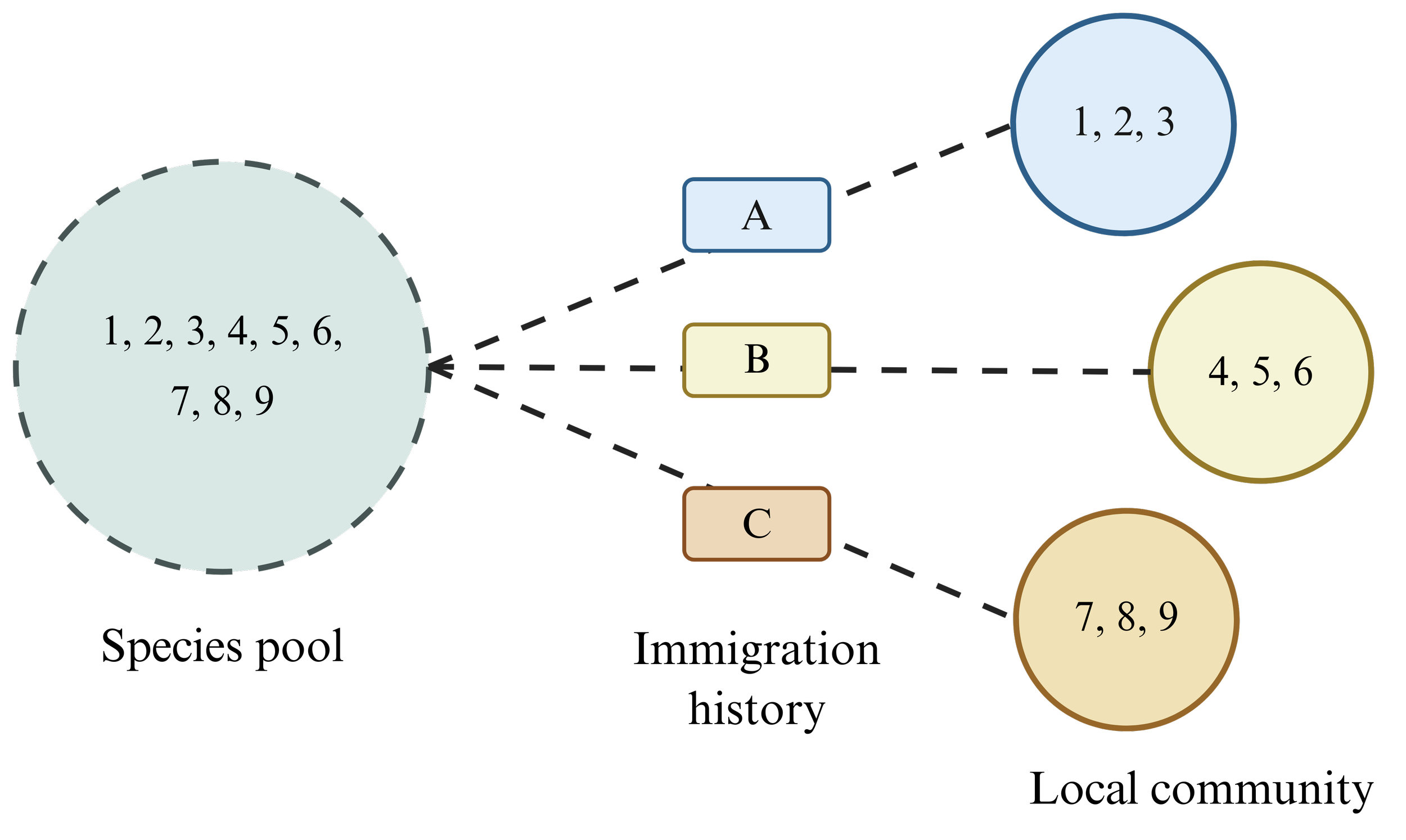
Fig 1. The role of historical contingency in community assembly. Adapted from Fukami (2010), this conceptual diagram illustrates how the sequence and timing of species arrival, priority effects, can shape ecological community structure. The hypothetical species pool includes all potential colonizers (1–9), each capable of establishing under similar environmental conditions. Immigration pathways (A, B, C) represent different colonization sequences drawn from the same pool. Despite identical starting conditions, variation in arrival order leads to distinct local communities, such as 1–3, 4–6, and 7–9. These outcomes result from the interplay between stochastic and deterministic processes, highlighting the role of historical contingency in driving community divergence.

Fig 2. Fungal endophytes as early colonizers in the leaf litter community. This schematic illustrates how fungal endophytes, already present in green leaves, transition into the leaf litter community upon leaf abscission (Tennakoon et al., 2021). Their early establishment influences subsequent colonization by external fungal decomposers, shaping community composition and contributing to carbon cycling during the decomposition of litter (Swift et al., 1979).
This research is supported and funded by the following:
-
-
Cobián lab: Diana Avila, Maredith Berdeja, & Jessica Moody
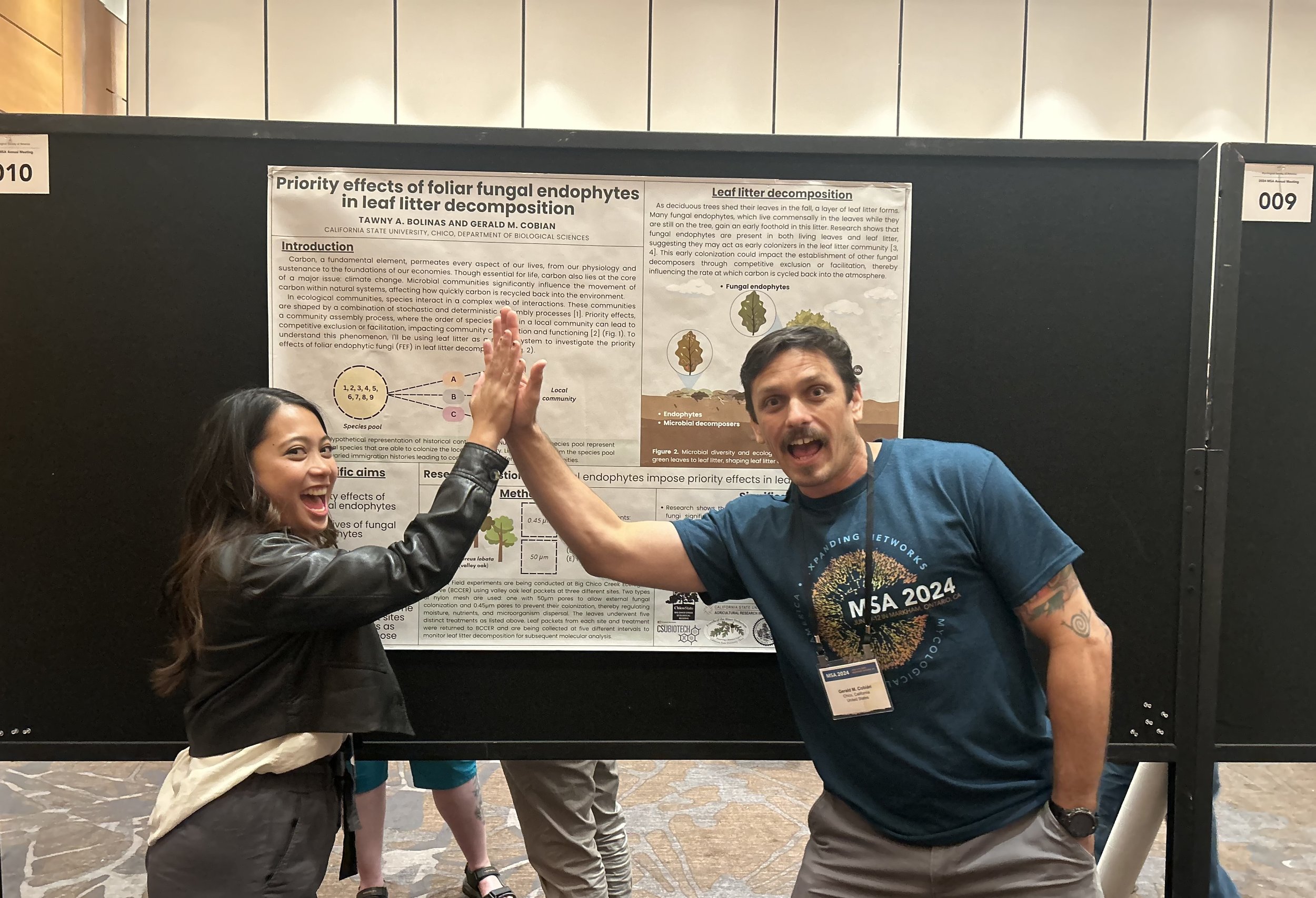
2025 Outstanding Thesis Award
Office of Graduate Studies
California State University, Chico